
July 14, 2026
Current Carrying and Thermal Management of High-Voltage Harness for Energy Storage Systems: Optimized Design From Conductor Cross-Section and Insulation Materials to Connector Temperature Rise
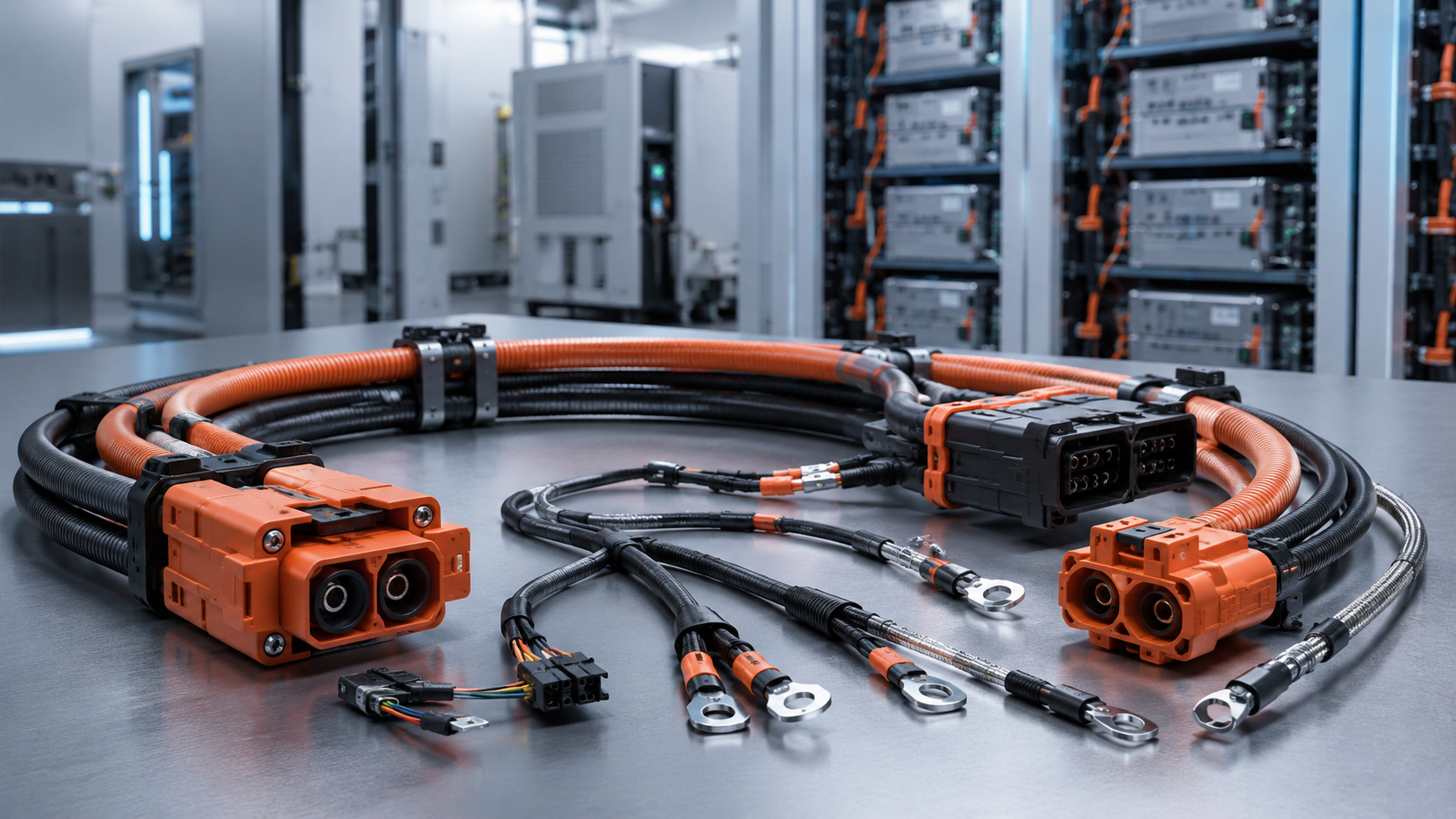
Table of Contents
1. Introduction
2. Core Functions of Energy Storage High-Voltage Harness
3. Conductor Cross-Section Selection and Current Carrying Capacity Optimization
4. Insulation Material Matching for Extreme Working Conditions
5. Connector Temperature Rise Control and Structural Optimization
6. Systematic Thermal Management Design for Energy Storage Harness
7. Performance Data Comparison of Optimized Harness Design
8. Conclusion
9. Industry FAQ
1. Introduction
Energy storage harness is the key power transmission component of battery energy storage systems. It undertakes high-current and high-voltage power transmission tasks for a long time.
Unlike ordinary low-voltage wiring, high-voltage harness used in energy storage faces severe challenges. Including continuous high current impact, cabinet internal high temperature and long cycle operation.
Unreasonable design will cause insufficient current carrying capacity, excessive connector temperature rise and insulation aging failure. These problems threaten the safety and service life of the entire energy storage station.
This article analyzes the full-link optimization design of energy storage high-voltage harness. It focuses on conductor cross-section, insulation material selection and thermal management strategies to solve common industry pain points.
2. Core Functions of Energy Storage High-Voltage Harness
High-voltage harness runs through battery clusters, PCS and cabinet power distribution modules. It is the power transmission backbone of energy storage equipment.
Stable current carrying performance ensures no power attenuation during peak charging and discharging. Reliable thermal management avoids thermal runaway risks caused by heat accumulation.
Most early harness failures in energy storage systems are caused by temperature rise overload and insulation damage, not circuit control failure.
3. Conductor Cross-Section Selection and Current Carrying Capacity Optimization
3.1 Matching Principle of Conductor Cross-Section
Conductor cross-section is the primary factor determining the current carrying capacity of energy storage harness. Too small cross-section will lead to severe current crowding effect.
When the energy storage system works at full load, excessive current density will produce massive Joule heat. It causes continuous temperature rise of the wire core.
Blind pursuit of small cross-section to save cost will greatly reduce system safety margin, especially in outdoor energy storage scenarios.
3.2 Current Carrying Optimization Strategy
According to energy storage industry design standards, different charging and discharging ratios correspond to different conductor specifications.
Reasonable cross-section design can stabilize current density within a safe range. It effectively reduces basic heat generation and improves continuous current carrying stability.
4. Insulation Material Matching for Extreme Working Conditions
Insulation material determines the high-voltage resistance, aging resistance and environmental adaptability of high-voltage harness.
Energy storage cabinets have closed and high-temperature operating environment. Ordinary insulation materials are easy to soften and age under long-term high temperature.
High-performance special insulation materials have excellent heat resistance and voltage resistance. It can maintain stable insulation performance under long-term thermal cycling.
Good insulation matching can avoid electric leakage and short circuit faults caused by insulation layer failure, cooperating with thermal management to improve overall safety.
5. Connector Temperature Rise Control and Structural Optimization
Connector temperature rise is the most vulnerable failure point of high-voltage harness systems. Poor contact and unreasonable structural design are the main causes.
In the process of frequent charge and discharge switching, contact resistance will increase with temperature accumulation. It further intensifies connector temperature rise and forms a vicious cycle.
Optimized connector structural design adopts high-precision crimping and shunt structure. It reduces contact resistance and effectively suppresses temperature rise deviation.
Strict temperature rise testing is necessary before mass application to ensure adaptability to full-load continuous operation.
6. Systematic Thermal Management Design for Energy Storage Harness
Single component optimization cannot solve all heat accumulation problems. The whole energy storage harness needs systematic thermal management design.
Heat generation sources include conductor power loss, connector contact loss and ambient heat radiation. All links need targeted heat dissipation design.
Reasonable harness wiring spacing and air duct matching can accelerate natural heat dissipation. It cooperates with material and structure optimization to control overall temperature within safe threshold.
7. Performance Data Comparison of Optimized Harness Design
The following test data comes from IEEE 2025 Energy Storage Electrical Component Test Standard. It compares the performance differences between conventional design and optimized design of energy storage high-voltage harness.
Performance Index | Conventional Harness Design | Optimized Harness Design | Optimization Effect |
Stable Current Carrying Limit | 210A | 285A | 35.7% Improvement |
Max Connector Temperature Rise | 58.2℃ | 39.6℃ | 31.9% Temperature Reduction |
Insulation High-Temperature Aging Life | 6500h | 12800h | 96.9% Life Extension |
Full-Load Operation Failure Rate | 4.2% | 0.8% | 81% Failure Rate Reduction |
8. Conclusion
The safety and stability of energy storage high-voltage harness depends on multi-dimensional collaborative optimization.
Scientific conductor cross-section selection guarantees reliable current carrying capacity. High-quality insulation materials adapt harsh operating environments.
Precise connector structure control suppresses excessive temperature rise. Systematic thermal management realizes long-term stable operation of energy storage harness.
This integrated design mode has become the mainstream standard for high-reliability energy storage system wiring solutions.
9. Industry FAQ
Q1: Why is connector temperature rise more dangerous than wire core heating?
A1: Connector contact resistance is much higher than conductor resistance. Local high temperature will cause rapid aging of insulation and ablation of contact points, which is the main trigger of energy storage harness safety accidents.
Q2: How does conductor cross-section affect current carrying and heat generation?
A2: Too small cross-section increases current density and Joule heat loss. Properly enlarged cross-section reduces current crowding, effectively improving current carrying capacity and reducing overall heat generation.
Q3: What is the core standard for selecting energy storage harness insulation materials?
A3: It needs high temperature resistance, high voltage resistance and anti-aging performance. It must adapt to closed cabinet heat accumulation and long-cycle charge-discharge working conditions.
Q4: What is the core of energy storage harness thermal management design?
A4: Control heat generation from the source through structural optimization, and accelerate heat dissipation through wiring layout. Realize dynamic balance of heat generation and heat dissipation for full-link temperature control.